Sensing and Feeling for Byosen: Developing Your Reiki Sensitivity

When we first begin to use Reiki as a healing modality, it can feel very strange and mysterious. The realisation that we can work with our own natural healing process and engage with all that we are can feel a little daunting at first.
However, this is where the focus should be for the newly attuned Reiki student: exploring their own unique energies and sensations within the body and also within their energetic field.
The traditional Reiki concept of Byosen is often described as the sensations or feedback perceived through the hands when practising Reiki. Learning to become aware of these subtle sensations can be an important part of developing sensitivity, intuition and confidence within your Reiki practice.
The 21–30 day period following an attunement can therefore be a valuable time for self-Reiki, observation and personal exploration.
It isn't simply about completing a set number of days.
It can become an opportunity to get to know yourself more deeply.
FREE ONLINE EVENT
-
FREE ONLINE EVENT -
FREE ONLINE REIKI SHARE
Monday 12th October 2026 | 7:30–8:30pm BST
If you'd like to explore your Reiki awareness further, you're warmly invited to join Ann for our free online Reiki Share on Monday 12th October.
A welcoming space to explore Reiki, self-healing, awareness and your own unique experience.
FREE TO ATTEND
Learning to notice your own energy
Just as flowers, plants, trees and animals have their own natural qualities and frequencies, so do we.
Our experience of ourselves can be influenced by emotional, spiritual, physical and mental experiences, as well as by what is happening around us.
Regular self-Reiki can gradually encourage us to become more aware of the sensations within our hands and body.
You may notice warmth, coolness, tingling, pulsing or pressure. Sometimes you may feel very little at all.
There is no right or wrong sensation.
The important thing is learning to observe rather than immediately trying to interpret everything you experience.
As your self-Reiki practice develops, you may find yourself naturally wanting to leave your hands in one particular area for longer, or change the way you work with an area through gentle touch, movement or stillness.
For me, this sensitivity has always been an important part of learning to listen to the body and to my own intuition.
What is Byosen?
Within Reiki, Byosen is traditionally associated with the sensations perceived through the hands during treatment.
These sensations can vary enormously from person to person and from one session to another.
You might experience:
Little or no noticeable sensation
Warmth or coolness
Tingling
Pulsing
Pressure
A feeling of heaviness or lightness
A sense that your hands want to remain in one particular position
There may also be moments where the sensations feel particularly strong.
I have personally experienced intense sensations through my hands while working with people who had serious health conditions. These experiences were part of my own Reiki practice and perception, rather than a diagnosis of what was happening within the body.
It is important to remember that Reiki practitioners do not diagnose illness. Sensations experienced during Reiki should not be interpreted as medical diagnosis or used as a substitute for appropriate medical care.
Instead, they can simply be observed as part of your personal Reiki experience.
Your hands can become your first teacher
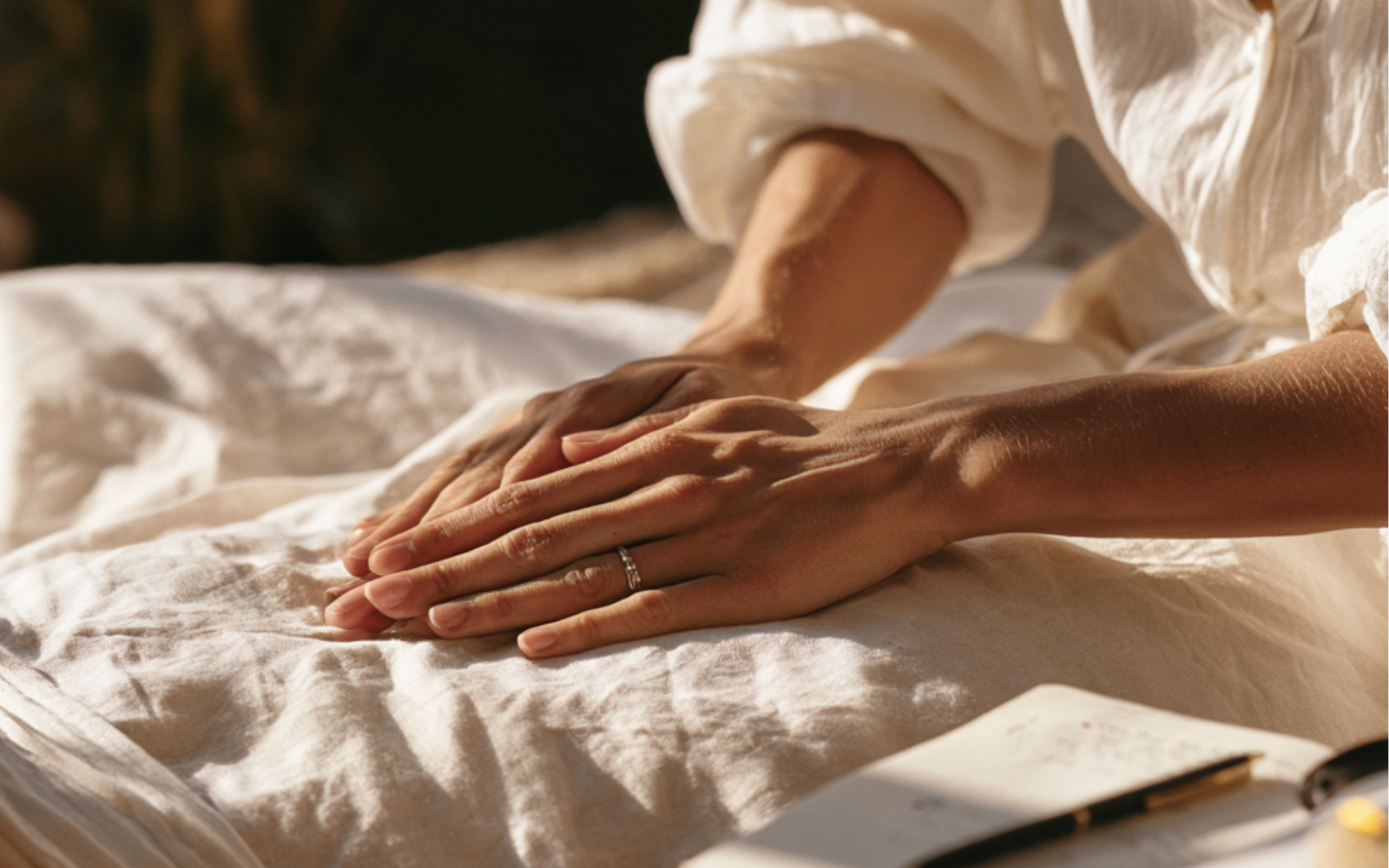
One of the beautiful things about practising self-Reiki is that you don't necessarily need someone else to tell you what you should be feeling. Your own hands can become a wonderful teacher.
Through regular practice, you may begin to notice subtle differences from one day to another.
Perhaps one area feels warmer.
Perhaps your hands seem to want to remain somewhere for longer.
Perhaps you notice a particular sensation around one of your chakra points.
Or perhaps you feel absolutely nothing on one day and something completely different the next.
This is where self-journaling can become incredibly useful. Instead of trying to remember every experience, simply write down what you noticed.
Using a body map to record your Reiki practice
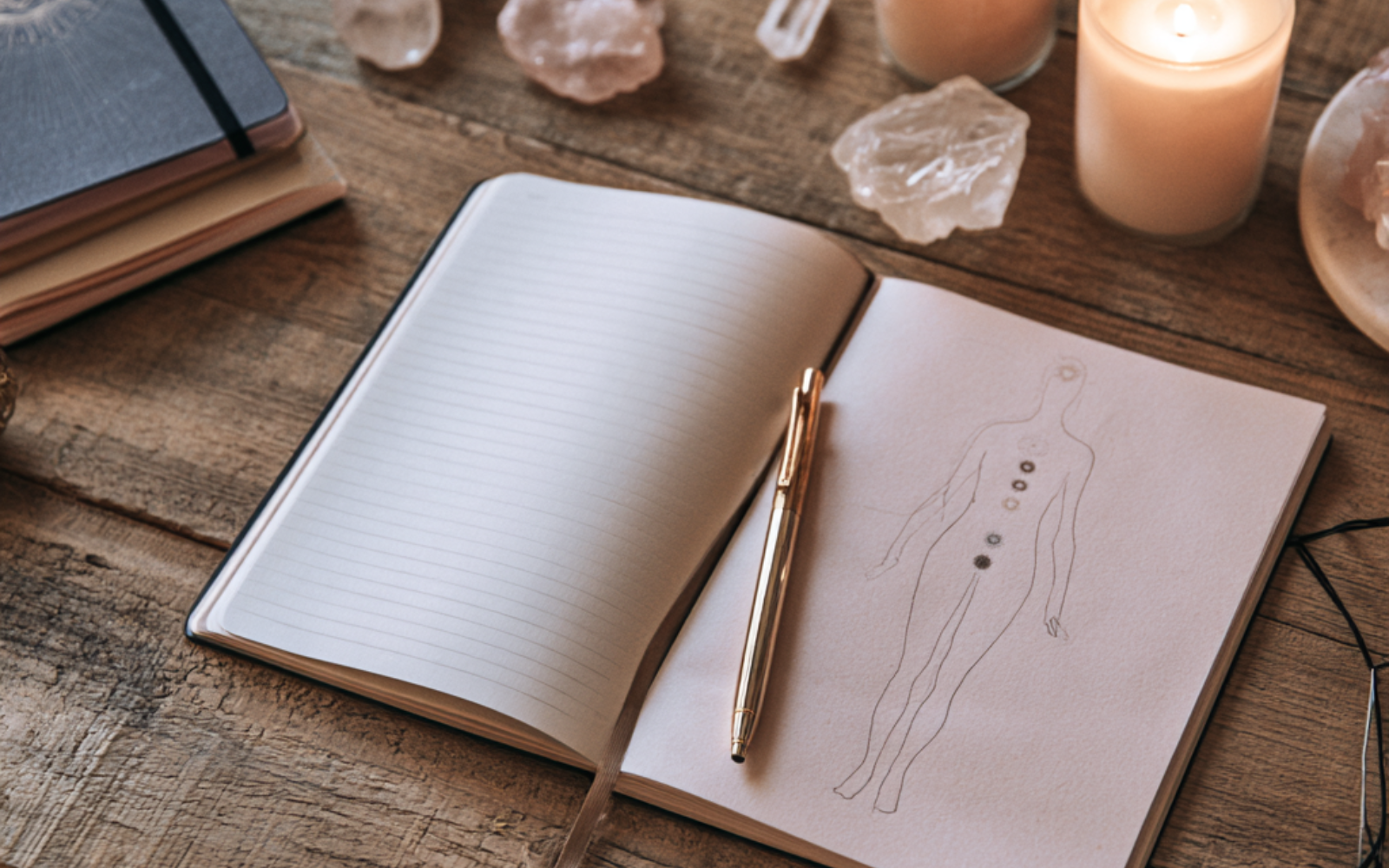
If you are a visual person, a Reiki body map can be a wonderful addition to your self-healing journal.
Explore our Reiki Body Map & Client Forms Here
You don't need to create complicated diagrams.
A simple outline of the body can allow you to record:
Where you placed your hands
Areas where you noticed stronger sensations
Chakra points you focused on
Feelings or emotions that arose
Areas where you naturally stayed longer
Anything that felt different from previous sessions
Thoughts, memories or intuitive impressions that came through
You can use simple symbols, arrows, colours or your own shorthand.
Over time, these body maps can become a visual record of your Reiki journey.
You may begin to notice patterns that you hadn't recognised before.
And sometimes, something you write down today may make much more sense when you look back at it weeks or months later.
Bringing the chakras into your observations
For those who work with the chakra system, your chakra points can also become useful reference points during self-Reiki. Rather than approaching the chakras as something you need to "fix", you can simply use them as areas of awareness.
As you move through your self-Reiki practice, notice what you experience around each area.
Does your attention naturally settle there?
Do you notice a physical sensation?
Does a particular emotion or thought arise?
Does your experience feel different from the previous session?
Again, there is no need to force an interpretation.
Simply notice.
Your body map, chakra observations and journal notes can then work together to create a personal record of your practice.
Journaling your Reiki experiences
One of the most valuable things you can do as a Reiki student is to write things down.
You don't need pages and pages of writing.

A few simple notes after each self-Reiki session can be enough.
You might record:
Date:
Length of practice:
Areas worked on:
Chakra focus:
Sensations noticed:
Emotions or thoughts:
Anything that felt different:
How I felt afterwards:
The purpose isn't to judge your experience.
It is to create space for reflection.
Your journal becomes somewhere you can return to and see how your awareness has developed.
Setting an intention
When we begin working with others, it can sometimes be tempting to think that the person receiving Reiki is simply lying there passively while the practitioner does all the work.
I don't see it that way. The recipient can be encouraged to participate through their own intention, awareness and willingness to engage with their experience. Setting an intention can be a simple but powerful part of beginning a Reiki session.
It might be an intention to relax.
To become more aware.
To let go of something that no longer serves you.
Or simply to give yourself permission to receive.
The mind can sometimes become a stumbling block. We can question ourselves, overthink what we are experiencing or convince ourselves that we aren't doing it "properly".
I have seen this many times, both within myself and while teaching others.
Sometimes we simply need to allow ourselves the space to experience rather than constantly trying to understand.
My own 'visioning' practice
When teaching my Level 1 Reiki students, I developed a technique within my own Reiki practice that I called visioning. It was inspired by the traditional practice of Gassho, bringing the hands together and connecting with the Reiki flow.
I found that by holding space for students to sit within their own experience of Reiki, they could be encouraged to observe their energy field almost as though they were viewing it from a third-person perspective.
I encouraged them to imagine their energetic field as having different gates or doorways into different areas of themselves. As they explored these imagined spaces, memories or emotions could sometimes arise that felt significant to them.
These might relate to past experiences, relationships, personal beliefs or memories that they felt needed acknowledgement, acceptance, forgiveness or simply compassion.
This isn't about forcing memories to appear or trying to find an explanation for every sensation.
It is about creating a safe space for observation and self-awareness.
Your Reiki journey is uniquely yours
Healing can feel complex and thought-provoking, but in its essence, my experience of Reiki is very simple.
Allow yourself to be present.
Allow yourself to notice.
Allow yourself to listen.
You don't have to understand everything immediately.
Sometimes the most valuable thing you can do is simply record what you experienced and return to it later.
Your body map, chakra observations and self-journal can become part of your own Reiki toolkit — a visual and written record of your developing sensitivity and self-awareness.
Over time, you may begin to recognise your own patterns, sensations and intuitive language.
And that is where the real journey begins.
Join me for a Free Online Reiki Evening
If this has sparked your curiosity about your own Reiki experience, I'd love you to join me for a special free online Reiki share via Zoom.
We'll create some space to explore Reiki, self-healing, awareness and your own unique experience of working with energy.
Monday 12th October 2026
7:30pm – 8:30pm BST
Online via Zoom
Free to attend
Whether you are newly attuned, have been practising Reiki for years, or simply feel curious about exploring your own energy and intuition, you are warmly invited.
Come exactly as you are.
Bring yourself, an open mind and somewhere comfortable where you can relax.
With love and Reiki blessings,
Ann, Reiki Master Teacher